Background information on marine debris and the virginia marine debris reduction plan
Click to scroll to a specific page section:
Have another resource for us to share? Contact Us and let us know!
Virginia Marine Debris Reduction Plan
Virginia marine debris stakeholders including government agencies, scientists, academics, nonprofits, and private industries, were brought together by the Virginia Coastal Zone Management Program (CZM) and Clean Virginia Waterways (CVW) to emphasize the need for collaboration to address the Commonwealth’s problematic and abundant types of litter and marine debris. With input from the stakeholders, Virginia CZM and CVW published the first Virginia Marine Debris Reduction Plan in 2014. Virginia’s plan was the first of its kind on the U.S. East Coast that strategically works to remove marine debris. The plan was updated in 2021-2025 and has four marine debris prevention and mitigation goals focused on consumer debris, derelict fishing gear, microplastics, and abandoned/derelict vessels. The 2026 - 2030 plan is currently under state review before publication for the public.
Watch the videos below to learn about the plan and the marine debris types!
Over the past few decades, production of plastic items and single-use disposable items has risen sharply -- especially food-related packaging, and beverage items (bottles, caps, cups, lids, straws, stirrers). The result can be seen in freshwater rivers, coastal waters, and the ocean where synthetic materials like plastic are found on the water surface, in the water column, and in the benthic (bottom) regions of water bodies.
The majority of marine debris (~80%) is made up of plastics. Other consumer debris includes glass, metal, rubber, and paper/cardboard.
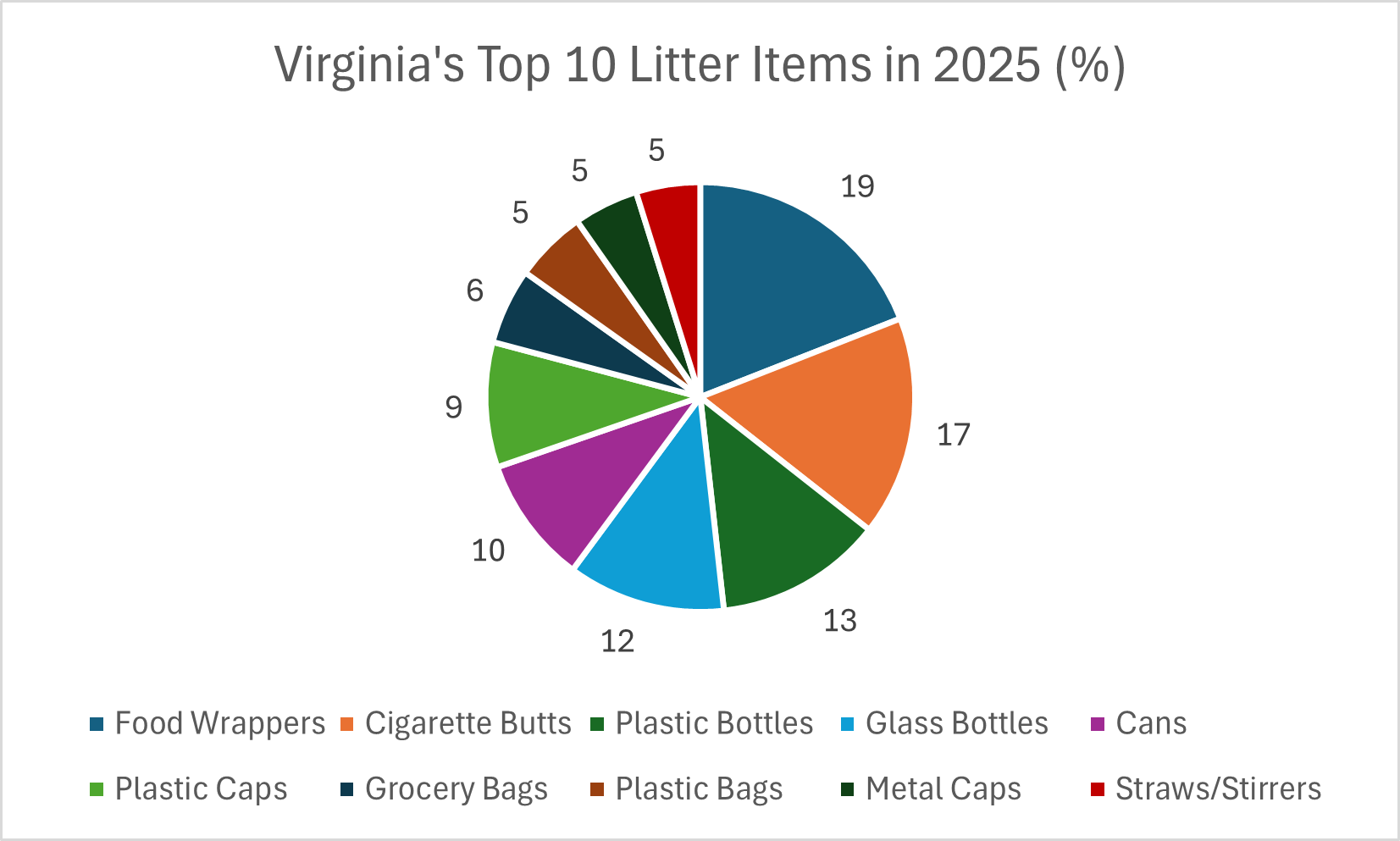
Left: A pie chart depicting Virginia's top 10 litter items in 2025 from Virginia Waterways Cleanup data. Food wrappers were the top marine debris item found in 2025.
Derelict fishing gear is any discarded, lost, or abandoned, fishing gear in the environment. It includes traps and crab pots; fishing line, hooks and weights; fishing nets; and oyster and other shellfish aquaculture equipment. Fishing line includes monofilament/nylon, fluorocarbon, and braided high-performance line.
Derelict fishing gear is sometimes referred to as “ghost gear,” since fishing gear continues to fish and trap animals. It can also entangle and kill marine life, smother habitat, and act as a hazard to navigation.
Microplastics are any piece of plastic less than 5 millimeters- about the size of a pencil eraser! Some microplastics come from fragmentation of larger pieces of plastic – for example, one plastic bottle can break down into hundreds or thousands of shards of microplastic over time. Microfibers, another type of microplastics, commonly come from polyester, rayon, nylon and other synthetic materials that shed from clothing, and from tire wear and tear.
When shed in the wash, microplastics travel through the sewer system, where they often pass through waste treatment plants and enter streams, rivers and eventually the marine environment or freshwater lakes. Microplastics shed outdoors from tire wear, or discarded cigarette butts. These microplastics get blown away in the wind or get swept away in the rain and contaminate our waters.
Abandoned and derelict vessels (ADV) are vessels in significant disrepair that may pose a threat to the public or the environment. “Derelict” frequently refers to vessels that are dilapidated with an identifiable owner, while “abandoned” vessels are those where the owner is unknown or has surrendered rights of ownership. ADVs often litter ports, waterways, marinas, and estuaries. They threaten our ocean, coasts, and waterways by obstructing navigational channels, causing harm to the environment, and diminishing commercial and recreational activities.
DID YOU KNOW?
The Virginia Marine Debris Reduction Plan was soon followed by NOAA's Mid-Atlantic Marine Debris Action Plan. Check out the Mid-Atlantic plan here.
Marine Debris/ Plastic Pollution Information
Explore these resources from Virginia-associated partners to learn more about marine debris!